





August 2026 Monthly
2 hours ago








The Bureau of Labor Statistics reported earlier this year that over 15 million wage and salary workers here in the United States are union members. This accounts for almost 13% of the labor force, and since the BLS began tracking union membership in 1983, this decline has been steady from a high of 20%.
It is fair for me to assume that anyone in this room tonight who does not already have a degree is working toward one, and with that degree you will join the other 123 million Americans who are not part of organized labor. Whether or not your job requires you to manage or interact with union employees, it is important to acknowledge the role of organized labor in our nation's past and future.
For this reason, everyone of us who went to school here in the United States was required to take social studies -- to ensure that the mistakes of our past are not the mistakes of our future. Throughout the course, we learned about Uriah Stephens and the Knights of Labor; how they built an effective labor force of nearly 750,000, and how their constitution called for an end to child labor and equal pay for the sexes -- an idea that was as progressive in 1869 as it is today. The Knights also called for the establishment of the Bureau of Labor Statistics as well as government ownership of the railroads.
We also learned about Samuel Gompers who founded the American Federation of Labor in 1886. An important win for the AFL came in 1916 when the Clayton Antitrust Act was passed, which stated explicitly that "the labor of a human being is not a commodity or an article of commerce". The AFL eventually merged with the Congress of Industrial Organizations in 1955 to form the AFL-CIO.
One of the most important incidents in the history of labor relations involved the Professional Air Traffic Controllers Association, or PATCO, and took place in 1981. When negotiations began in February of that year, PATCO President Robert Poli brought a list of 97 grievances to the table, among them: 7 were money related, 2 were related to work hours, 5 had to do with equipment, and 60 referred to working conditions.
Indeed, the greatest concerns for PATCO members involved job stress and workplace control. Two federal studies were done on the FAA to investigate low morale among the controllers -- one in 1970 and another in 1972. Both stated the FAA's relationship between management and labor were in disarray, and that many job stressors were related to the autocratic management at the FAA. The 1970 study urged a sharp reduction both in work hours and required overtime, in addition to a revision in pay criteria.
The FAA not only ignored most of the recommendations in these reports, but also ended an immunity provision in 1979 that encouraged pilots, administrators, and controllers to openly discuss mistakes without fear of retribution, just as surgeons do.
PATCO President Robert Poli received this letter from then Governor Ronald Reagan on October 20, 1980, shortly before being elected President:
Dear Mr. Poli, I have been briefed by the members of my staff as to the deplorable state of our nation's air traffic control system. They have told me that too few people working unreasonable hours with obsolete equipment has placed the nation's air travelers in unwarranted danger. In an area so clearly related to public safety, the Carter Administration has failed to act responsibly. You can rest assured that if I am elected President, I will take whatever steps are necessary to provide our air traffic controllers with the most modern equipment available and to adjust staff levels and work days so that they are commensurate with achieving a maximum degree of public safety. I pledge to you that my administration will work very closely with you to bring about a spirit of cooperation between the President and air traffic controllers.
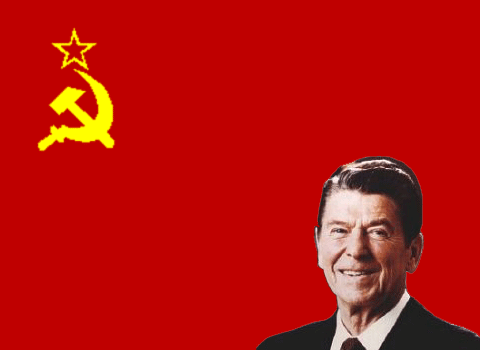
When 13,000 of PATCO's members walked off the job on August 3, 1981, the Great Communicator ordered them back to work within 48 hours or face termination. As federal employees, they were in violation of the "no-strike" clause of their employment contract, though that clause had not stopped postal workers or employees at the Government Printing Office and Library of Congress from having twenty-two other unauthorized strikes in recent years. Nevertheless, an angry Reagan fired the 11,359 controllers who had not returned to work on August 5th and banned them from returning to work for the FAA. This ban was lifted by President Clinton in 1993, but some controllers still want their jobs back. Ron Taylor, a former Vietnam veteran and air traffic controller fired in 1981, was interviewed just two weeks ago in USA Today. Of the ban he says, "Reagan banned us for life, even murders get parole. We thought we, as labor, had a friend in the Whitehouse". As a final slap in labor's face, Washington National Airport was renamed in 2002 to pay homage to the man who fired the air traffic controllers.
Which begs the question: how important is organized labor? It was vital to our nation's growth, so much so that Congress declared the first Monday in September "a working man's holiday" in 1894. While union membership has been in decline, they are likely to see a resurgence in the coming years as issues like off shoring of jobs and violations of World Trade Organization Rules continue. While I am not a union member now, I am certainly proud to have been one.


